The new model for 1998 was the GT Limited sedan, a GT with leather, an automatic and a six-speaker stereo with CD and weatherband, sold in white, Rio Red or Black Granite. All Legacys got multi-reflector headlights and, from September 1997 production, lower-powered airbags. The Brighton wagon gained a right-side mirror and L wagons gained rear head rests. Most prices held at 1997 levels.
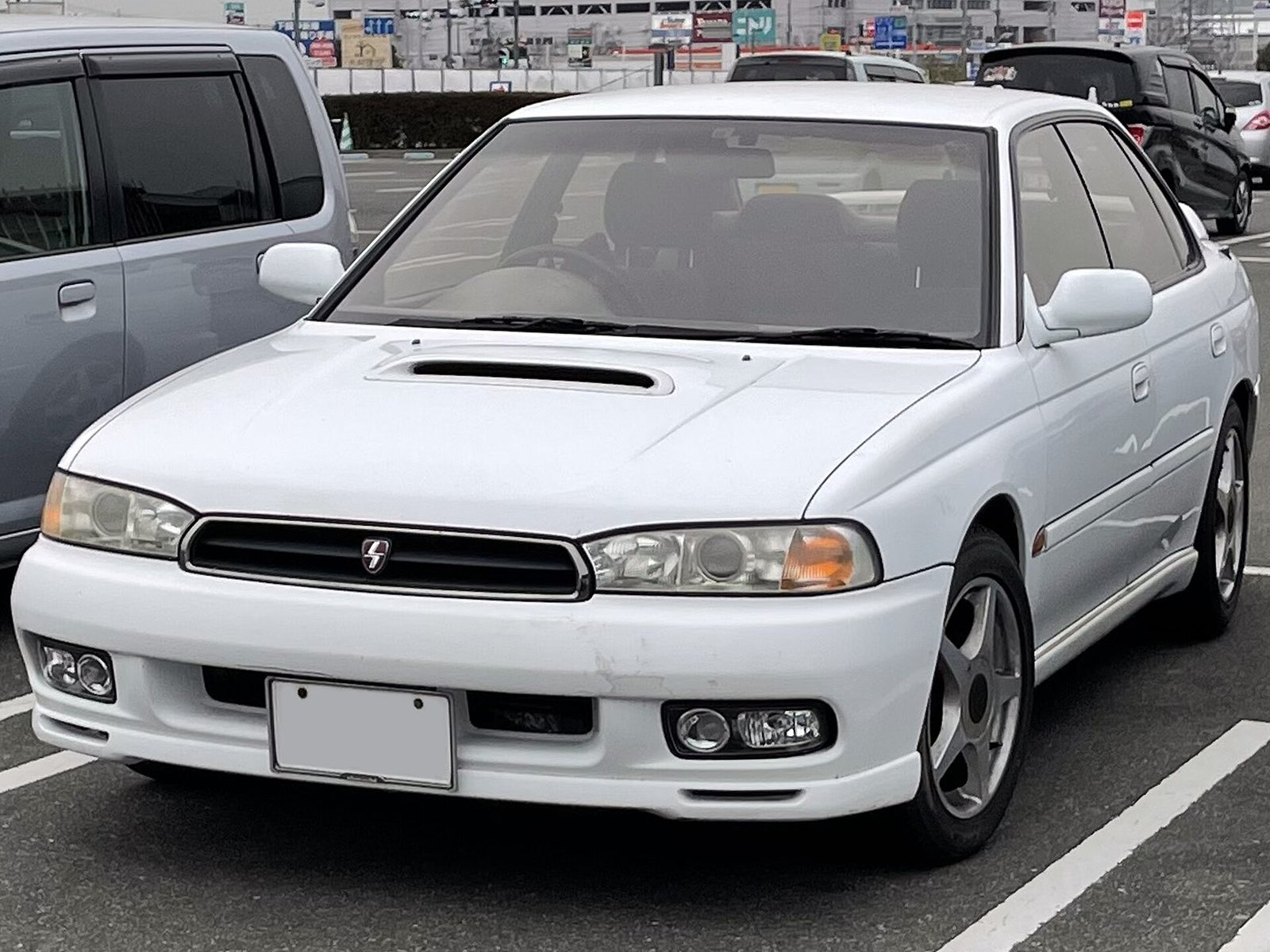
White second-generation Subaru Legacy RS sedan with a hood scoop and fog lamps in a parking lot; the plate is blank Photo credit and more on the BD page →
Year by year
The 1998 model year
United States
What changed in the United States
New GT Limited sedan with leather and automatic
De-powered airbags from September 1997 production
Multi-reflector headlights
Rear defroster timer; ashtray and lighter standard
L wagons gain rear head rests and an overhead map light
Trims, United States
Brighton wagon
L
GT
GT Limited sedan
Facts and figures, United States
Price range
$17,390 (Brighton wagon, manual) to $25,390 (GT Limited sedan), including $495 destination
The second-generation wagon gave way to the new car on 17 June 1998, and the sedan was replaced by the B4 in December. Fuji Heavy Industries counts 961,825 second-generation cars, Outback included: 495,471 in Japan and 466,354 in Indiana.
What changed in Japan
Wagon replaced 17 June; sedan in December
Facts and figures, Japan
Production
961,825 second-generation cars: 495,471 in Japan and 466,354 at Subaru-Isuzu Automotive
Second-generation registrations in Japan. a. Japanese Wikipedia gives 495,471 as Japanese new-car registrations; Fuji Heavy Industries' 2005 release gives the same 495,471 as second-generation cars built in Japan, exports included. ↩
Order sheet
1998 Legacy options and prices
Option or package
Price
Source
Brighton wagon (base vehicle)
$17,390 / $18,190 (5-speed / automatic), including $495 destination
Ratings as the EPA lists them at fueleconomy.gov; for 2007 and earlier these are the EPA's revised figures, restated on the test method used since 2008, so they read lower than the original window sticker.
NHTSA lists 5 safety recalls that include the 1998 Legacy. Not every car is in every recall; a Subaru dealer or NHTSA's VIN lookup shows what is open on one car. Recall repairs are free.
Vehicle description: passenger vehicles equipped with front coil springs originally sold in or currently registered in the states of connecticut, delaware, illinois, Indiana, iowa, kentucky, maine, maryland, massachusetts, michigan, minnesota, missouri, new york, new jersey, new hampshire, ohio, pennsylvania, rhode island, vermont, virginia, west virginia, and wisconsin, and in the district of columbia. The front coil springs were produced with poor paint quality which, after continued exposure to corrosive salt, can result in breakage of the spring.
Risk: Depending on the location of the fracture, a broken spring could move past the spring seat and contact a front tire. Some tires have deflated due to contact with a broken spring.
Fix: Dealers will notifiy customers to bring their vehicle to an authorize dealership to have a spring guard installed on both front struts to prevent tire puncture and replace any broken springs free of charge. Owner notification began september 18, 2001. Owners who take their vehicles to an authorized dealer on an agreed upon service date and do not receive the free remedy within a reasonable time should contact Subaru at 1-800-782-2783.
This is not a safety recall in accordance with the safety act. However, it is deemed a safety improvement campaign by the agency. Vehicle description: passenger vehicles. Some of these vehicles have an alternator problem that can result in a loss of charging capability.
Risk: If the alternator fails, the alternator warning telltale will alert the driver to the problem, giving ample opportunity to seek repair before a loss of battery power, which, if the warning were ignored, could ultimately result in a loss of vehicle power (engine stall).
Fix: Dealers will replace the alternator with a modified alternator. Owners will also be cautioned that, should the alternator telltale warning lamp illuminate, they must seek immediate repair to avoid the eventual loss of electrical power, which could result in an engine stall.
Service brakes, hydraulic: foundation components, master cylinder
Vehicle description: passenger and sport utility vehicles equipped with anti-lock braking system (ABS). (the 1999 2.2 liter Legacy vehicles are excluded). In extremely cold weather, the brake pedal goes to the floor and the vehicle stopping distance is increased.
Risk: This condition causes the vehicle stopping distance to be increased, possibly resulting in a crash.
Fix: Dealers will replace the brake master cylinder.
Vehicle description: passenger vehicles, also service parts supplied to Subaru dealers are involved (lot numbers F01 J21D2, F01 J30D2, F02 J09D1, F02 J09D2, and F02 J20D1). The purolator oil filter cans used on these vehicles can fracture causing a vaporized oil spray and subsequent oil leak.
Risk: This vaporized oil spray can result in oil vapor ignition by the hot exhaust system resulting in a possible underhood fire.
Fix: Dealers will inspect and replace these engine oil filters.
Power train: automatic transmission, gear position indication (prndl)
Vehicle description: passenger vehicles equipped with automatic transmissions. Due to poor welds, ignition keys can stick, shift levers/linkages can break and shift levers can move.
Risk: This condition can cause unexpected movement of the vehicle increasing the risk of a crash or property damage.
Fix: Dealers will replace the automatic transmission shift lever assemblies (except the handle grip).
Specifications
BD Legacy specifications
These figures cover the whole generation (1993–1999); each says which market and model year it applies to.
Years and markets
Japan from October 1993 to June 1998; U.S. through model year 1999; Liberty in Australia from October 1993
Gunma Yajima, Japan; Subaru-Isuzu Automotive, Lafayette, Indiana. Outback production at Lafayette from June 1995; engine assembly there from July 1995.
Japan: twin-turbo 250 PS (automatic GT), 260 PS from June 1996, 280 PS (manual RS and GT-B). U.S.: 2.2 at 135 hp at 5,400 rpm and 140 lb-ft at 4,400 rpm; 2.5 at 155 hp (1996), then 165 hp and 162 lb-ft (1997).
Front-wheel drive standard with optional AWD at launch; AWD standard in the U.S. from 1997 per Cars101, which prices front-drive L models for 1996 (Wikipedia's infobox says 1996), while Japan and Europe kept front drive to 1999
U.S. 1995: $16,955 for a Legacy L wagon. U.S. 1999: $19,690 to about $26,000; 2.5 GT Limited sedan $24,895 plus $495 destination. Japan, October 1993, tax included: sedan ¥1,513,000 (TX) to ¥2,764,000 (RS); Touring Wagon ¥1,782,000 (TX) to ¥3,193,000 (GT B-spec).
Wheelbase. The Auto Channel's 1995 road test lists 103 in. ↩
Curb weight. Wikipedia gives a maximum of 3,135 lb. ↩
Fuel economy. EPA shows these cars on its restated 2008 basis. The Auto Channel's 1995 test printed the window-sticker 22/28 mpg for an automatic L wagon. ↩
Buy · Own
Buying and owning a 1998 Legacy
Ask for head-gasket service history on a 1996–2004 non-turbo Legacy
Ask for head-gasket service history. Repair-trade press describes the naturally aspirated SOHC EJ25 in 1996–2004 Legacy models as failing more often than the DOHC version, usually starting as a slow oil or coolant leak around 100,000 miles. Ask whether the head gaskets have been replaced and ask for the receipts.
Watch for slow seepage, not sudden failure. The leak is gradual coolant or oil loss, not a blowout, so a quick cold look can miss it. Check the coolant top-off history and look for residue where the heads meet the block.
Confirm the exact engine before assuming the caution applies. The reports cover the naturally aspirated SOHC EJ25. The turbocharged and DOHC engines sold in the same years are not part of the pattern, so check the engine code.
Track coolant level as routine maintenance on a 1996–2004 non-turbo Legacy
Repair-trade press describes the naturally aspirated SOHC EJ25 in this window as prone to a slow head-gasket leak, usually near 100,000 miles. Check the coolant level at every oil change instead of waiting for a warning light.
The earliest reported sign is a gradual, unexplained need to top off coolant over several fill-ups; a sudden overheat comes late.
Not every non-turbo Legacy of this era develops it. Watch for oil or coolant seepage at the head joint.
Resolves the BD/BG/BK chassis-code ambiguity by confirming BG (stepped-roof wagon) and BK (flat-roof wagon) are two distinct wagon variants, not conflicting codes.
15 March 2005 release with a Legacy chronology (Gunma Yajima production from November 1988, Japan launch February 1989, U.S. introduction April 1989, SIA production from September 1989, Outback production at SIA from June 1995, GT-B 280 PS June 1996, Lancaster 6 May 2000) and a production table by generation split between Japan and SIA, Outback included.
SOHC (vs. DOHC) EJ25 failing "much more frequently"; 1996-2004 as the main affected years; ~100,000-mile failure clustering starting as oil/coolant leak; cross-family engine use (Baja/Forester/Impreza/Legacy/Outback); TSB extending "only to 2008 model year"; standard warranty limits (3yr/36k, 5yr/60k powertrain); 2014 coolant-pellet....
Underhood Service (underhoodservice.com), a trade publication · accessed 2026-07-22
Legacy launched 1989 in Japan (formally released January 23, 1989) to compete against Honda Accord/Toyota Camry/Mazda 626/Nissan Stanza in the North American mid-size segment — article body, first-generation section (flagged {{citation needed}} in the article itself as of access date for the "positioned to compete" framing, though a....
EPA city, highway and combined ratings, engine, transmission, fuel and electric range for every U.S.-market Subaru from model year 1984. Ratings for 2007 and earlier are the EPA's revised figures on the post-2008 method.
U.S. Environmental Protection Agency and U.S. Department of Energy (fueleconomy.gov) · accessed 2026-11-17