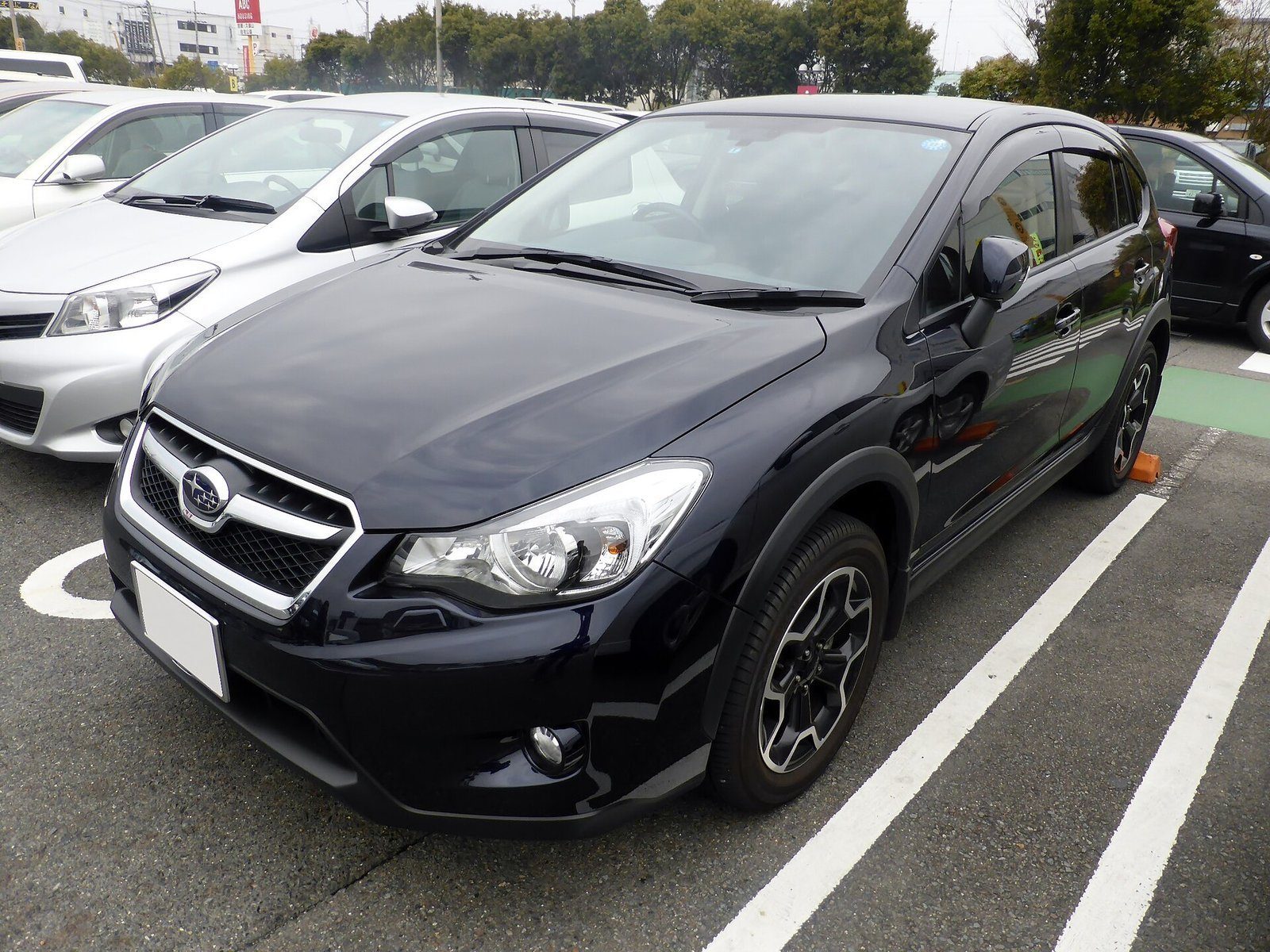
The 2013 XV Crosstrek was new to the U.S. lineup. It was a raised five-door with 8.7 inches of ground clearance, 17-inch alloy wheels and a 148 hp 2.0-liter boxer. Subaru sold two trims. The Premium came with a five-speed manual or the Lineartronic CVT, and the Limited was CVT only. The first cars reached dealers in September 2012.
Dark blue first-generation Subaru XV 2.0i-L EyeSight in a Japanese parking lot, front three-quarter view; the plate is blank Photo credit and more on the GP page →
Year by year
The 2013 model year
What changed for 2013
New model for the U.S.
148 hp 2.0-liter FB boxer with five-speed manual or CVT
8.7 inches of ground clearance and standard 17-inch alloys
IIHS named it a 2012 Top Safety Pick in October 2012
Tangerine Orange Pearl, Desert Khaki, Venetian Red Pearl, Ice Silver Metallic, Dark Gray Metallic, Satin White Pearl, Marine Blue Pearl, Crystal Black Silica
NHTSA lists 3 safety recalls that include the 2013 XV Crosstrek. Not every car is in every recall; a Subaru dealer or NHTSA's VIN lookup shows what is open on one car. Recall repairs are free.
Subaru of America, Inc. (Subaru) is recalling certain 2014-2016 Forester, 2008-2016 Impreza sedans, 2012-2016 Impreza station wagons, 2008-2014 WRX sedans (including STI), and 2013-2017 Crosstrek vehicles. Exposure to certain contaminants may cause the brake light switch to malfunction, preventing the brake lights from illuminating and also preventing keyless ignition vehicles from starting and CVT/automatic transmissions from being able to be shifted out of Park.
Risk: Brake lights that do not illuminate properly will not alert other drivers that the vehicle is slowing or stopping, increasing the risk of crash.
Fix: Subaru will notify owners, and dealers will replace the brake light switch, free of charge. The recall began April 15, 2019. Owners may contact Subaru customer service at 1-844-373-6614. Subaru's number for this recall is WUE-90.
Subaru of America, Inc. (Subaru) is recalling certain 2012-2014 Subaru Impreza, 2012-2013 Impreza Stationwagon, 2013 Subaru BRZ, XV Crosstrek and Toyota Scion FR-S vehicles. The engine valve springs in these vehicles may fracture causing an engine malfunction or a possible engine stall.
Risk: An engine stall can increase the risk of a crash.
Fix: Subaru will notify their owners. Toyota will notify the FR-S owners. Dealers will replace the valve springs, free of charge. The recall began December 26, 2018. Subaru owners may contact Subaru customer service at 1-844-373-6614, Toyota owners may contact the Toyota Customer Experience Center at 1-888-270-9371. Subaru's number for this recall is WTY-84.
Subaru is recalling certain model year 2010-2012 Legacy and Outback vehicles equipped with an automatic or CVT transmission and an Audiovox remote engine starter (RES) accessory, certain model year 2012-2013 Impreza vehicles equipped with a CVT transmission and an Audiovox remote engine starter (RES) accessory, and certain model year 2013 XV Crosstrek vehicles equipped with a CVT transmission and an Audiovox remote engine starter (RES) accessory. Additionally included are certain model year 2013 Legacy and Outback vehicles that may have received replacement RES fobs. If the RES fob is dropped, the fob may malfunction and randomly transmit an engine start request without pressing the button.
Risk: The engine may inadvertently start and run for up to fifteen minutes. The engine may continue to start and stop until the fob battery is depleted, or until the vehicle runs out of fuel. If the vehicle is parked in an enclosed area, there is a risk of carbon monoxide build-up which may cause headaches, dizziness or, in extreme cases, unconsciousness and/or asphyxiation.
Fix: Subaru will notify owners, and dealers will replace the RES key fobs, free of charge. The recall began on April 22, 2013. Owners may contact Subaru at 1-800-782-2783 for more information.
Specifications
GP XV Crosstrek specifications
These figures cover the whole generation (2012–2017); each says which market and model year it applies to.
Years and markets
XV shown at Frankfurt, September 2011; Japan sales from 25 September 2012; U.S. model years 2013–2017 (XV Crosstrek 2013–2015, Crosstrek 2016–2017); XV Crosstrek Hybrid MY2014–2016
U.S.: 148 hp (110 kW) at 6,200 rpm, 145 lb-ft (197 N·m) at 4,200 rpm. Hybrid: 160 hp (119 kW) at 6,000 rpm and 163 lb-ft (221 N·m) at 2,000 rpm system; motor 13.4 hp, 47.9 lb-ft (65 N·m)
Confirm the 2013 XV Crosstrek's valve-spring recall (NHTSA 18V-772 / WTY-84) was completed
Check recall completion via VIN. The same NHTSA campaign 18V772 (Subaru's WTY-84) that covers the 2013 BRZ also covers the 2013 XV Crosstrek's FB20 engine, a different engine family from the BRZ's FA20, for valve springs that may fracture and cause an engine malfunction or stall. Check completion by VIN.
Note this recall doesn't extend past the 2013 model year. The recall covers the 2013 model year (plus the 2012-2014 Impreza, which shares the FB20). A 2014-2017 GP-era Crosstrek falls outside this campaign.
Ask about CVT service and warranty-extension history on a 2013-2015 Crosstrek
Know that Subaru extended the CVT warranty on this range once already. After owner complaints, Subaru extended CVT warranty coverage in 2017 from the original 5 years/60,000 miles to 10 years/100,000 miles for roughly 1.5 million vehicles, including the 2013-2015 Crosstrek and 2014-2015 Crosstrek Hybrid (per Forbes and CarComplaints). It was a voluntary customer-satisfaction program, not a safety recall, and on an early Crosstrek it has likely run out by now. Ask whether any CVT repair or replacement was done under it, and ask for the paperwork.
Watch for shudder, hesitation, or delayed acceleration. Repair-trade and complaint sources describe shuddering, stalling, whining or clunking from the CVT on this generation. If the test drive shows any of these, have a transmission specialist look before you buy; CVT replacement is commonly quoted in the thousands of dollars.
Know your CVT's warranty-extension history on an early Crosstrek
In 2017, after owner complaints, Subaru extended CVT warranty coverage on this range from 5 years/60,000 miles to 10 years/100,000 miles. The voluntary customer-satisfaction program covered the 2013-2015 Crosstrek and 2014-2015 Crosstrek Hybrid; it was not a safety recall. If you paid for a CVT repair after your original warranty ran out but inside that extended window, you may have been due reimbursement.
Watch for shudder, hesitation, whining or clunking from the transmission, and don't write off an early symptom as normal CVT behavior; a full CVT replacement is commonly quoted in the thousands of dollars.
Subaru of America's 2013 XV Crosstrek press kit and spec sheet: 148 hp at 6,200 rpm, 145 lb-ft at 4,200 rpm; 103.7-in wheelbase, 175.2 in long, 70.1 in wide, 63.6 in high with roof rails, 8.7-in ground clearance, 3,087–3,164 lb, 22.3/51.9 cu ft cargo, 15.9-gal tank.
Premium 5MT $21,995, Premium CVT $22,995, Limited $24,495; destination $795. Eight exterior colours; dealer arrivals from late September 2012; prices announced 16 August 2012.
Subaru of America's 26 August 2013 release: the 2014 XV Crosstrek Premium manual keeps its $21,995 MSRP; the 2014 Tribeca comes only as the 3.6R Limited at $34,095, with 256 hp and 247 lb-ft.
Primary basis for the 2013 BRZ (FA20)/XV Crosstrek (FB20) valve-spring recall (began December 26, 2018) affecting 2012-2014 Impreza, BRZ, XV Crosstrek, and FR-S, requiring dealer replacement of the fractured valve springs.
Documents Subaru's 2017 extension of CVT warranty coverage from 5yr/60k to 10yr/100k across 1.5 million vehicles, framed as a consumer-complaint response rather than a formal safety recall.
EPA city, highway and combined ratings, engine, transmission, fuel and electric range for every U.S.-market Subaru from model year 1984. Ratings for 2007 and earlier are the EPA's revised figures on the post-2008 method.
U.S. Environmental Protection Agency and U.S. Department of Energy (fueleconomy.gov) · accessed 2026-11-17
Fuji Heavy Industries' 29 October 2012 release: the Subaru XV, launched in September 2012, sold 4,277 units in Japan between 25 September and 28 October, against a monthly target of 1,000.