Vivio · 1992–1998
A four-cylinder kei hatch that went rallying in Kenya.
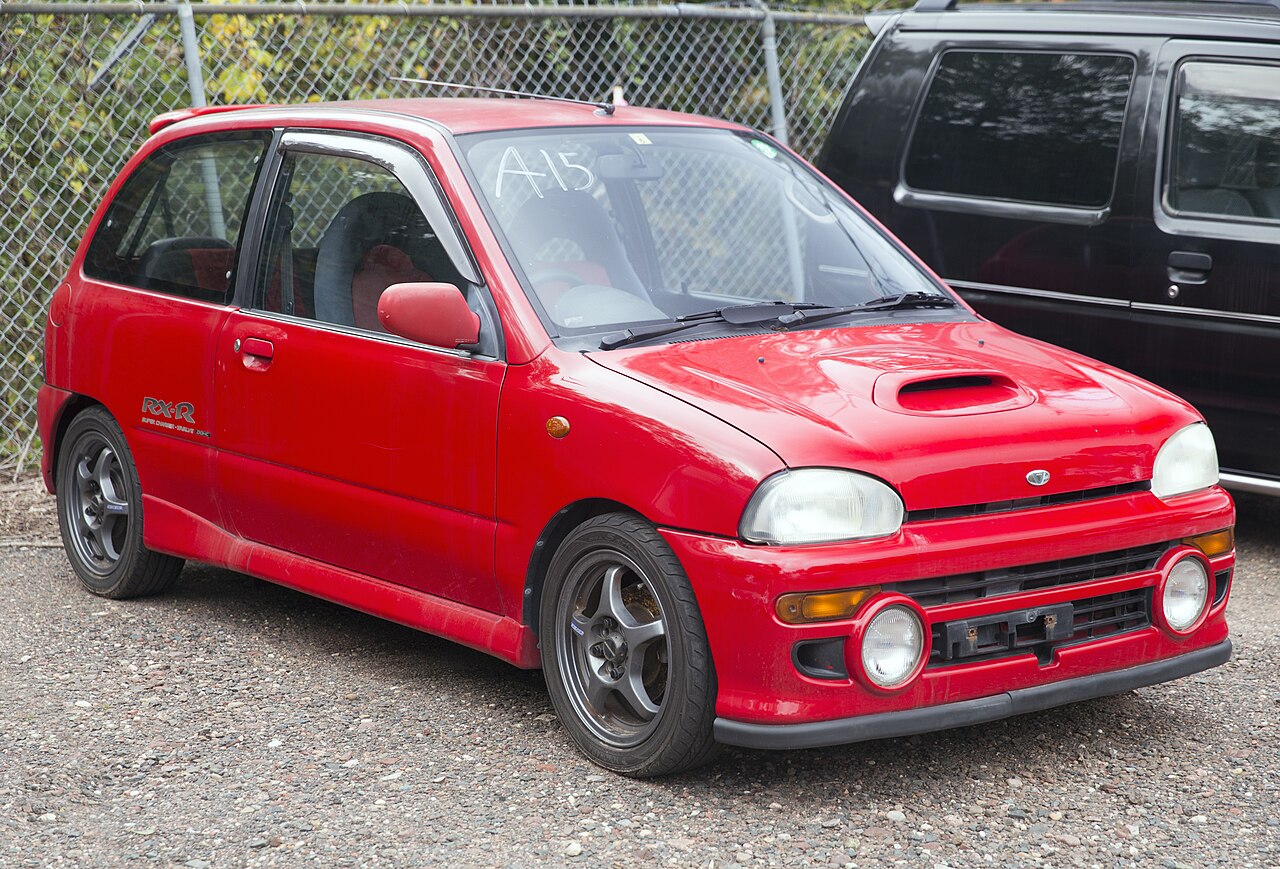
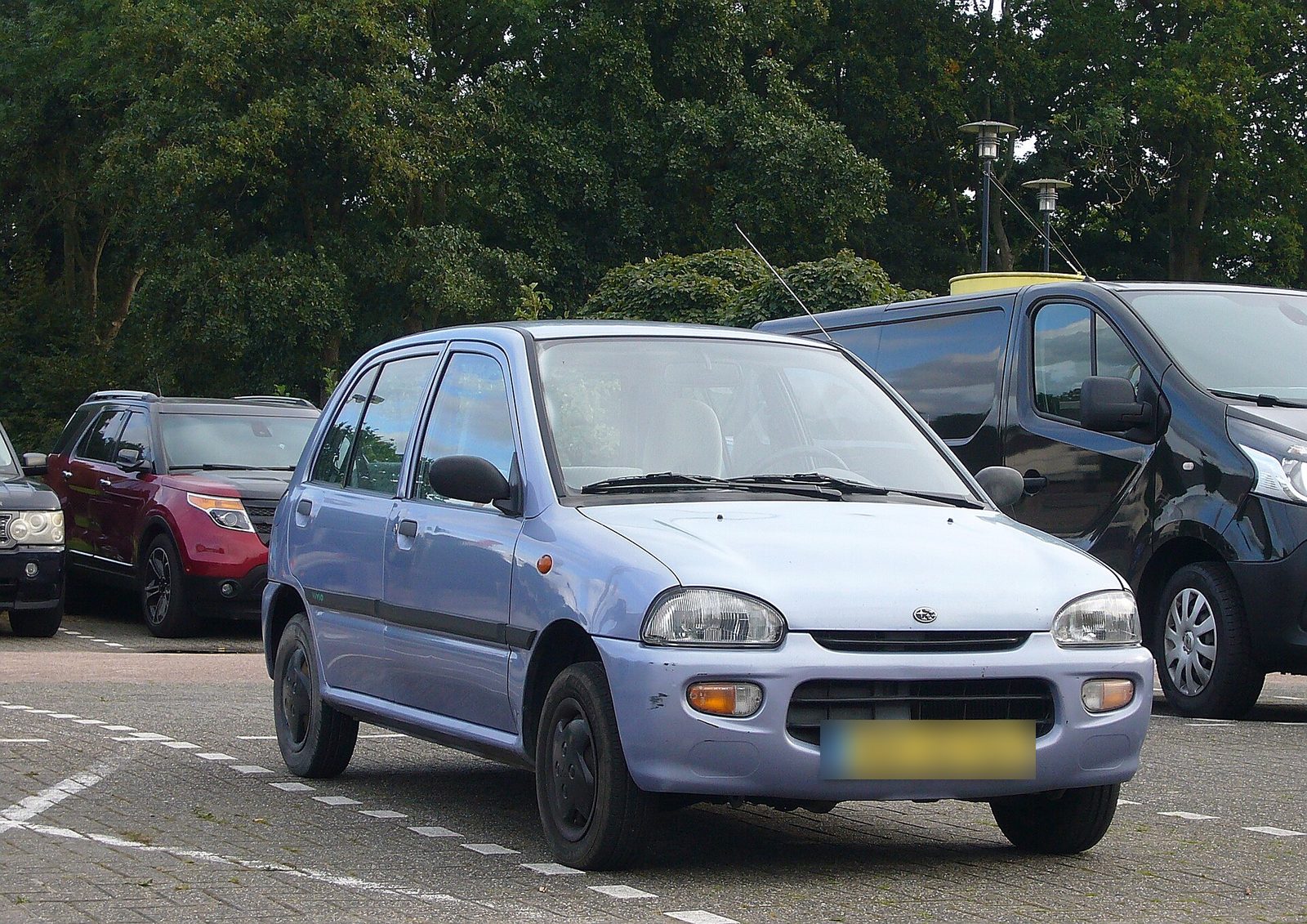
The Vivio replaced the Rex in March 1992 and ran until the Pleo took over in October 1998. Every version used the 658 cc EN07 four-cylinder: 42 PS carbureted in the van, 48 or 52 PS fuel-injected, and 64 PS supercharged, with the DOHC 16-valve RX-R at the top. Bodies were 3- and 5-door hatchbacks, a 3-door van and a 3,000-car T-top targa. Three Vivios ran the 1993 Safari Rally, one of them driven by Colin McRae. Japanese Wikipedia gives 747,045 built.
Japan from March 1992, with European exports; a 1993 Safari Rally entry. No U.S. sale.
SpecificationsFigures are labelled with the market and model year they apply to; the source for each is linked beside it.
Specifications
Vivio at a glance
| Years and markets | Japan: March 1992 to November 1998 (production ended September 1998). Exported to Europe with the Japanese 658 cc fuel-injected engine a | Wikipedia 2 , Subaru Corporation |
|---|---|---|
| Chassis codes | KK3 (2WD), KK4 (4WD), KW3/KW4 (commercial van), KY3 (T-top and GX-T) | Wikipedia , IDOM Inc. (Gulliver, 221616.com) |
| Body styles | 3- and 5-door hatchback, 3-door van, 2-door targa T-top | Wikipedia 2 |
| Assembly plant | Subaru-chō Plant, Ōta, Gunma, Japan; T-top completed by Takada Kogyo, Yokohama; built in China as the Guizhou Yunque GHK7070 | Wikipedia 2 |
| Engines | 658 cc EN07 inline-four: SOHC carbureted (van), SOHC multi-point injection, SOHC supercharged, DOHC 16-valve supercharged (RX-R) | Wikipedia 2 , IDOM Inc. (Gulliver, 221616.com) |
| Output | Carbureted: 42 PS (31 kW) at 7,000 rpm. Fuel-injected: 48 PS (35 kW) at 6,400 rpm with ECVT, 52 PS (38 kW) at 7,200 rpm with manual. Supercharged SOHC: 64 PS (47 kW) at 6,400 rpm, 84 N·m (62 lb-ft) at 4,400 rpm. RX-R DOHC: 64 PS at 7,200 rpm, 88 N·m (65 lb-ft) at 4,000 rpm. Europe: 44 PS DIN b | IDOM Inc. (Gulliver, 221616.com) , Wikipedia |
| Transmissions | 5-speed manual; ECVT; 3-speed automatic (van from April 1995); SPORTSHIFT ECVT with 6-speed manual mode (RX-SS and GX-SS, 1997) | Wikipedia 2 |
| Drive system | Front-wheel drive; part-time 4WD; viscous-coupling full-time 4WD | Wikipedia , IDOM Inc. (Gulliver, 221616.com) |
| Wheelbase | 2,310 mm (90.9 in) | Wikipedia , IDOM Inc. (Gulliver, 221616.com) |
| Overall length | 3,295 mm (129.7 in) | Wikipedia 2 , IDOM Inc. (Gulliver, 221616.com) |
| Width | 1,395 mm (54.9 in) | Wikipedia , IDOM Inc. (Gulliver, 221616.com) |
| Height | 1,375–1,385 mm (54.1–54.5 in) | Wikipedia , IDOM Inc. (Gulliver, 221616.com) |
| Curb weight | 620–780 kg (1,367–1,720 lb) c | IDOM Inc. (Gulliver, 221616.com) |
| Fuel capacity | 32 L (8.5 US gal) | IDOM Inc. (Gulliver, 221616.com) |
| Ground clearance | 140–160 mm (5.5–6.3 in) | IDOM Inc. (Gulliver, 221616.com) |
| Fuel economy | Japan 10-15 mode: 16.8 km/L (RX-RA) to 21.5 km/L (40–51 mpg US) | IDOM Inc. (Gulliver, 221616.com) |
| Base price | Including tax: 546,000 yen to 1,462,000 yen (RX-R S1 4WD); T-top 1,198,000–1,258,000 yen | IDOM Inc. (Gulliver, 221616.com) |
| Production | 747,045 (Japanese Wikipedia, citing DeAgostini). Limited editions: RX-R S1 500 (1992), T-top 3,000 (1993), GX-T 1,000 (1994), RX-R Special Version 200 (1995) | Wikipedia 2 |
Powertrain
Powertrain details
One engine block, four tunes
Every Vivio used the 658 cc EN07 Clover 4 inline four, carried over from the Rex and mounted crosswise. Gulliver's grade listings give 42 PS at 7,000 rpm for the carbureted van engine, 48 PS at 6,400 rpm for the fuel-injected engine with ECVT and 52 PS at 7,200 rpm with the manual, and 64 PS for both supercharged engines, at 6,400 rpm for the SOHC and 7,200 rpm for the DOHC 16-valve RX-R. English Wikipedia gives the RX-R 88 N·m against 84 N·m for the supercharged SOHC, and 44 PS DIN for the European fuel-injected car.
From the E type of October 1996 the DOHC cars ran on premium fuel with a torque-biased tune. Gulliver lists the 1997 to 1998 RX-R and RX-RA at 10.8 kgf·m (105.9 N·m) at 3,600 rpm. Magazine tests reported 182 km/h for an RX-R with the 130 km/h limiter removed, a Nürburgring lap in 9 minutes 54 seconds and 1 minute 13.35 seconds at Tsukuba for the front-drive RX-R.
Transmissions were a 5-speed manual, Subaru's ECVT with an electromagnetic powder clutch, and from April 1995 a 3-speed automatic for the van. The ECVT clutch failed often in van use, which is why the van switched. In 1997 the RX-SS and GX-SS paired the DOHC engine with the SPORTSHIFT ECVT and its 6-speed manual mode. Drive was front-wheel, part-time 4WD or viscous full-time 4WD, and Japanese Wikipedia says Subaru sold a higher share of 4WD Vivios than its rivals did.
Sources: Gulliver new/used car catalog: Subaru Vivio and Vivio Bistro, March 1992 to November 1998 · Subaru Vivio (Wikipedia) · スバル・ヴィヴィオ (Japanese Wikipedia) ·
| Engine | Years | Power | Torque |
|---|---|---|---|
| EN07 SOHC carbureted (van) | 1992–1998 | 42 PS (31 kW) at 7,000 rpm | 5.3 kgf·m (52 N·m) at 4,500 rpm |
| EN07 SOHC fuel-injected | 1992–1998 | 48 PS (35 kW) at 6,400 rpm with ECVT; 52 PS (38 kW) at 7,200 rpm with manual | 5.5–5.6 kgf·m (54–55 N·m) |
| EN07 SOHC supercharged (GX, GX-T, GX-R, GX-L) | 1992–1998 | 64 PS (47 kW) at 6,400 rpm | 8.5–8.6 kgf·m (84 N·m) at 4,400 rpm |
| EN07 DOHC 16-valve supercharged (RX-R, RX-RA, RX-SS, GX-SS) | 1992–1998 | 64 PS (47 kW) at 7,200 rpm (6,400 rpm with SPORTSHIFT ECVT) | 9.0 kgf·m (88 N·m) at 4,000 rpm; 1997–98 premium-fuel RX-R listed at 10.8 kgf·m (105.9 N·m) at 3,600 rpm |
Configuration
Model details
Replacing the Rex with a car built as a sedan first
Subaru put the Vivio on sale in March 1992 as the Rex's replacement, and its own 2017 annual report lists 1992 as the release year. The name comes from the English vivid and from 660 written loosely in Roman numerals, VI VI O. Production ended in September 1998 when the kei rules changed, and the last cars were sold in November; English Wikipedia ends production in October 1998. Japanese Wikipedia gives 747,045 built, citing DeAgostini's Weekly Japanese Famous Cars.
Dimensions held for the whole run: 3,295 mm long, 1,395 mm wide, 1,375 to 1,385 mm tall, on a 2,310 mm wheelbase. Weights in Gulliver's grade listings run from 620 kg to 780 kg, and every car carried a 32-liter tank. The cabin was laid out for the driver, with the passenger seat and the center tunnel shifted toward the left. Japanese Wikipedia says the body was designed to the 40 km/h frontal crash standard of full-size cars, when kei cars had to meet 30 km/h.
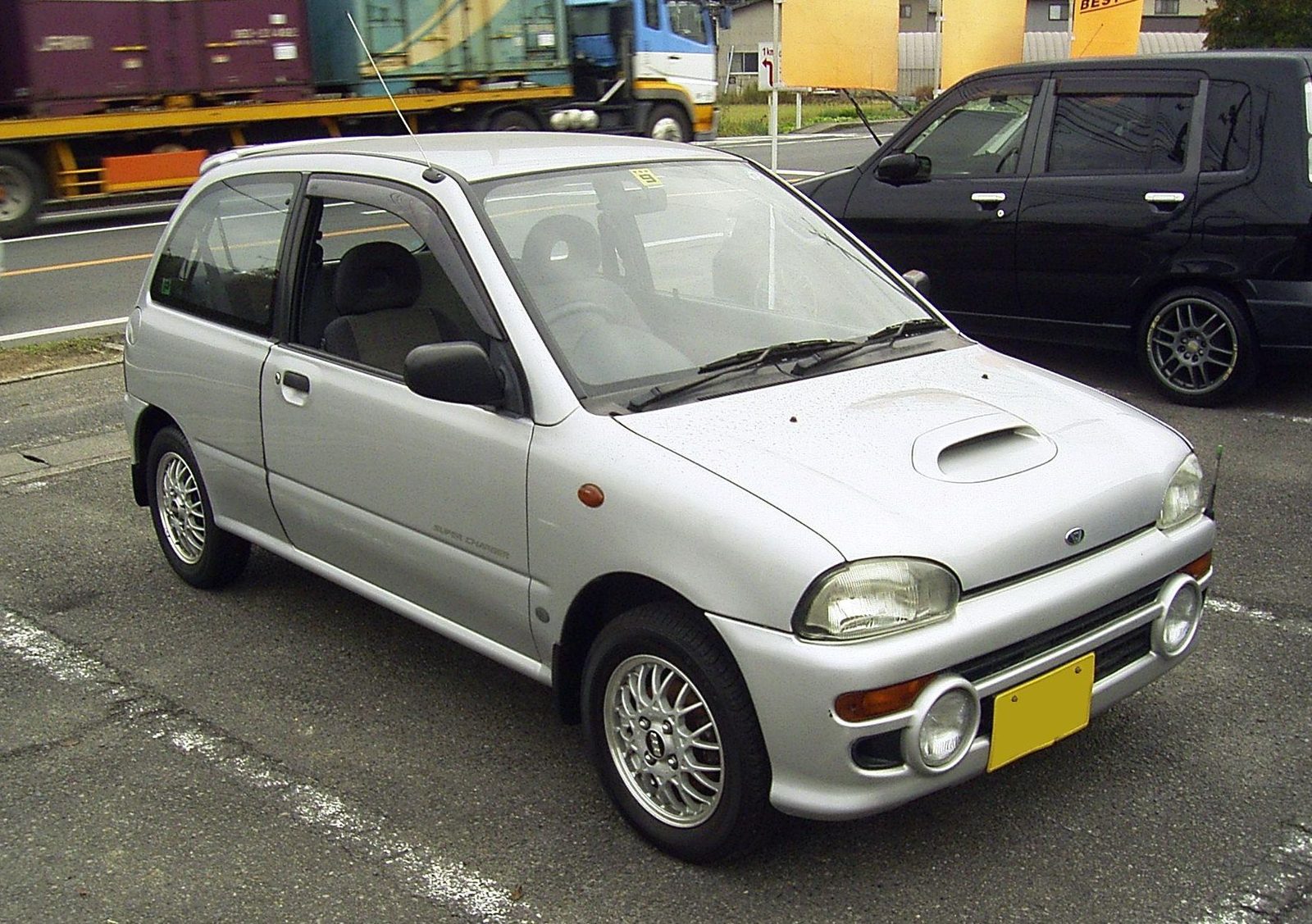
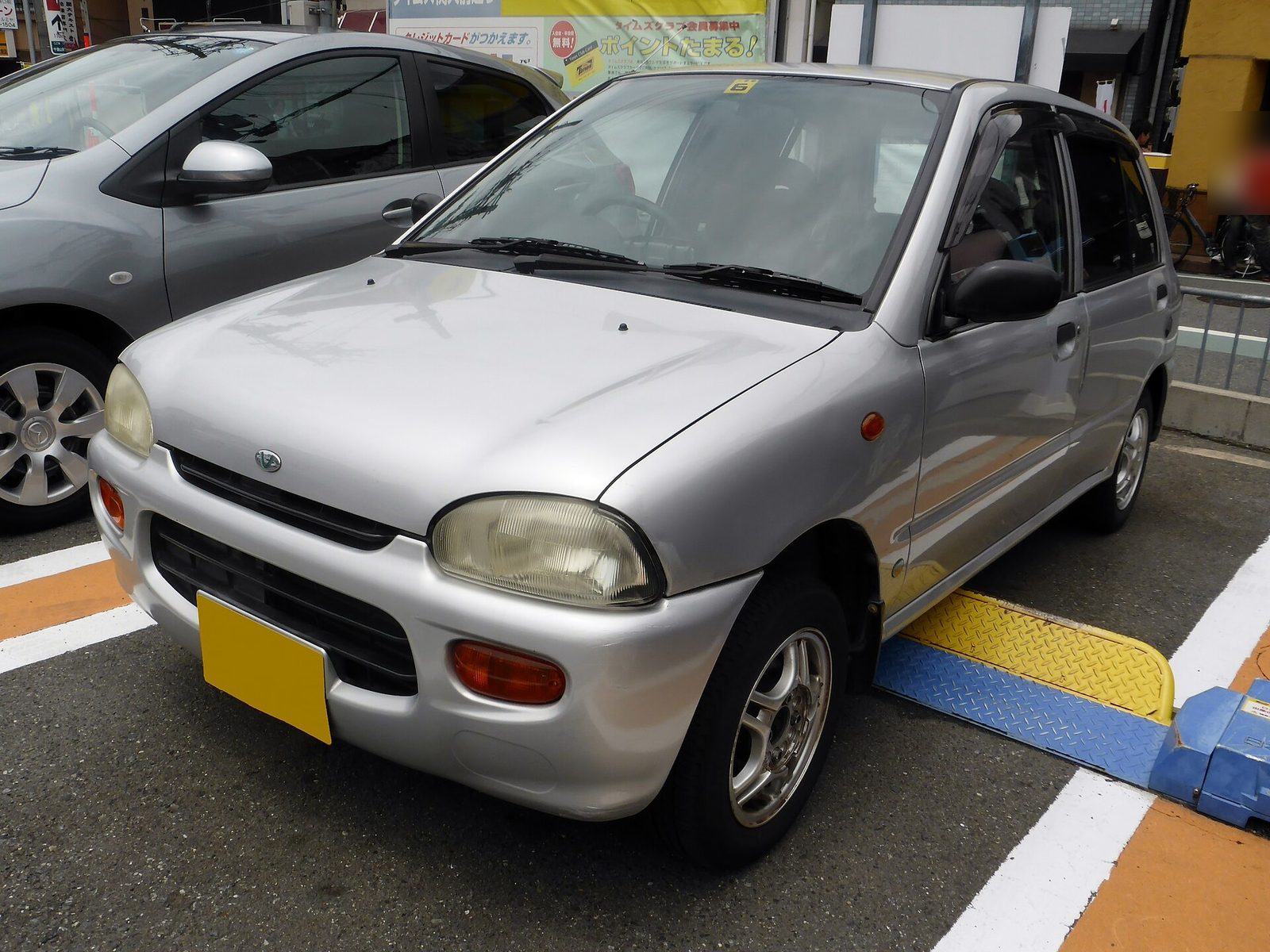
The range spread wide. Passenger cars came as 3- and 5-door hatchbacks, the van as a 3-door with its own rear lamps and a wider hatch opening, and prices including tax ran from 546,000 yen to 1,462,000 yen for an RX-R S1 4WD. Limited editions were the RX-R S1 (500 cars, September 1992, for 20 years of Subaru 4WD), the T-top (3,000, May 1993), the GX-T (1,000, February 1994) and an RX-R Special Version of 200 cars in May 1995. The Bistro, with a retro front end and Nissan Figaro taillamps, arrived in November 1995 and carried sales through the later years.
Sources: スバル・ヴィヴィオ (Japanese Wikipedia) · Subaru Vivio (Wikipedia) · Gulliver new/used car catalog: Subaru Vivio and Vivio Bistro, March 1992 to November 1998 · Annual Report 2017: History of the SUBARU Group and SUBARU models through the years ·
The T-top, the GX-T and the Safari Rally
The T-top was a 2-door targa with a power-retracting rear window, built for Subaru by Takada Kogyo of Yokohama, the convertible specialist that also assembled the Nissan Figaro. It used the fuel-injected SOHC engine at 48 PS with the ECVT or 52 PS with the 5-speed manual, front drive only, and cost 1,198,000 to 1,258,000 yen. The 1,000-car GX-T that followed in February 1994 used the 64 PS supercharged SOHC engine with the ECVT.
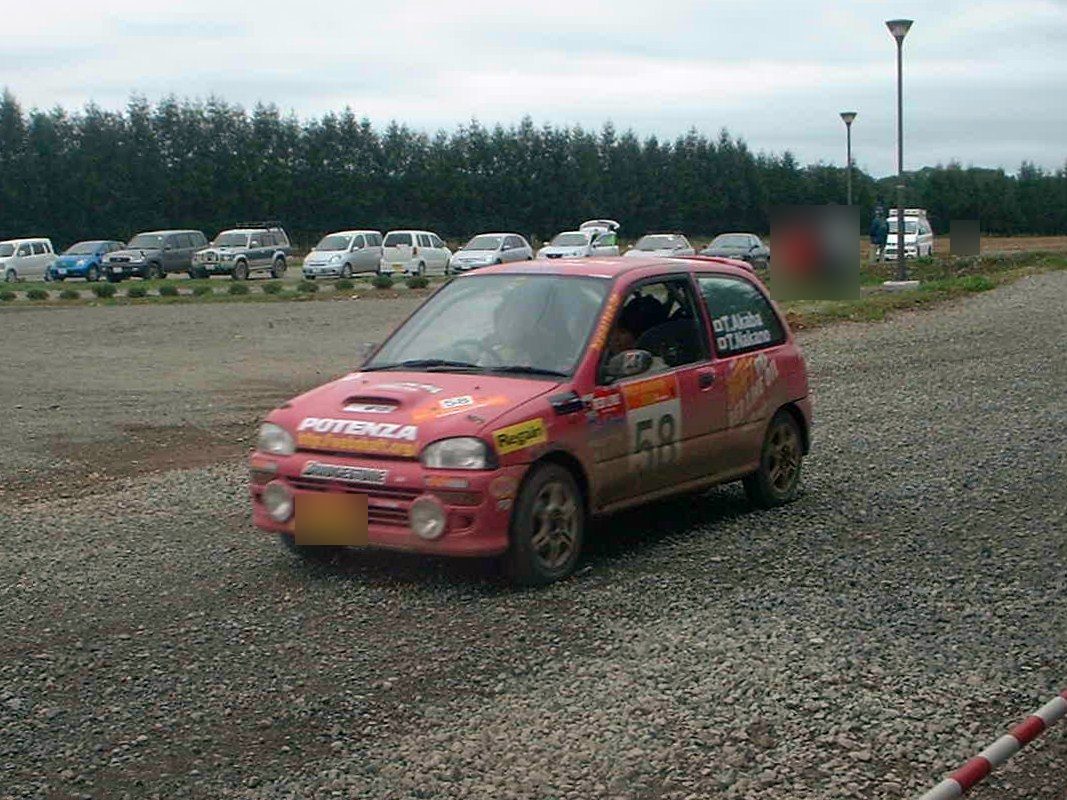
Subaru Tecnica International founder Noriyuki Koseki entered three Vivios in the 1993 Safari Rally, run from 8 to 12 April. The FIA homologation name for the RX-R was Super KK, and English Wikipedia puts the rally engine at 85 PS at 6,000 rpm. Juwra's results show Patrick Njiru 12th overall in car 7, Colin McRae retired at control 15 with broken suspension in car 6, and Masashi Ishida retired at control 44 with a failed head gasket in car 8. Only 17 of 44 starters finished.
Japanese Wikipedia tells it differently: four Vivios, with the Group A5 class win and a second place in class for a fourth driver it names as Francisco Villazner. Juwra's classified finishers list one Vivio. Subaru marked the Safari class result with the 200-car RX-R Special Version in May 1995. Before the Safari, a privately entered RX-R ran the 1992 Paris-Moscow-Beijing raid and beat the works Mitsubishi Pajeros on the prologue.
Sources: Safari Rally 1993 final results (juwra.com) · Subaru Vivio (Wikipedia) · スバル・ヴィヴィオ (Japanese Wikipedia) · Gulliver new/used car catalog: Subaru Vivio and Vivio Bistro, March 1992 to November 1998 ·
Grades ran from the 2-seater van and el up through em, ex, es and the M300 series to the supercharged GX family and the DOHC RX-R. The RX-RA was the competition base: closer first-to-fourth ratios, stiffer suspension, a mechanical rear limited-slip differential and no air conditioning or power windows, 20 kg lighter than an RX-R. The Bistro retro series arrived in November 1995.
Identify & buy
Identification and ownership notes
Reading the plate and picking a grade
The type code tells the body: KK3 for a front-drive passenger car, KK4 for 4WD, KW3 and KW4 for the commercial van, and KY3 for the T-top and GX-T. Applied types run from A in 1992 through B (September 1993), C (1994), D (October 1995) and E (October 1996). A forum compilation gives K as the platform letter of Subaru's Applied Model code for the Vivio. Rear brakes were drums on every Vivio, the RX-R included.
European Vivios kept the Japanese 658 cc fuel-injected engine, where the Rex, the Suzuki Alto and the Daihatsu Cuore were exported with larger engines. The Vivio was also built in China as the Guizhou Yunque GHK7070. Privateers kept entering Vivios in Rally Japan long after production ended.
For a buyer, the ECVT is the known weak point, especially in a van. A DOHC car from 1996 on wants premium fuel. A T-top or GX-T is a 1993 to 1995 car with a KY3 plate, and some have been rebuilt with RX-R running gear.
Sources: スバル・ヴィヴィオ (Japanese Wikipedia) · Subaru Vivio (Wikipedia) · Gulliver new/used car catalog: Subaru Vivio and Vivio Bistro, March 1992 to November 1998 · Subaru Legacy International (sl-i.net) forum archive — "Applied Model Decoding and Chassis Codes Explained" ·
Type codes on the plate: KK3 passenger 2WD, KK4 passenger 4WD, KW3/KW4 van, KY3 T-top and GX-T. Applied types run A (1992) to E (October 1996).
Follow the evidence
Sources
- スバル・ヴィヴィオ (Japanese Wikipedia)
Vivio codes KK3/KK4/KW3/KW4/KY3, sales March 1992 to November 1998 (production ended September 1998), engine variants, Applied types A to E, special editions with limits (RX-R S1 500, T-top 3,000, GX-T 1,000, RX-R special version 200), 40 km/h crash design, Nurburgring and Tsukuba magazine times, 1993 Safari entry account, Chinese Guizhou Yunque GHK7070, and 747,045 production cited to DeAgostini's Weekly Japanese Famous Cars no. 47.
Wikimedia Foundation (Japanese Wikipedia contributors) · accessed 2026-11-14 - Subaru Vivio (Wikipedia)
All variants used the 658cc "Clover" (EN07) four-cylinder, in naturally aspirated and supercharged forms; top RX-R/RX-RA trims: supercharged DOHC 16-valve.
Wikimedia Foundation · accessed 2026-07-22 - Gulliver new/used car catalog: Subaru Vivio and Vivio Bistro, March 1992 to November 1998
Grade-by-grade Japanese catalog data for the Vivio: type codes E-KK3/E-KK4/V-KW3/V-KW4/E-KY3, 3,295 x 1,395 x 1,375-1,385 mm, 2,310 mm wheelbase, 620-780 kg, 32 L tank, outputs 42/48/52/64 PS with rpm, torque in kgf·m and N·m, 10-15 mode fuel economy, and new-car prices including consumption tax (546,000 to 1,462,000 yen).
IDOM Inc. (Gulliver, 221616.com) · accessed 2026-11-14 - Safari Rally 1993 final results (juwra.com)
1993 Trust Bank Safari Rally (8-12 April 1993) classification: Patrick Njiru 12th overall in Vivio no. 7; Colin McRae (no. 6) retired at TC15 with suspension failure; Masashi Ishida (no. 8) retired at TC44 with head-gasket failure; 44 starters, 17 finishers.
Jonkka's World Rally Archive (juwra.com) · accessed 2026-11-14 - Annual Report 2017: History of the SUBARU Group and SUBARU models through the years
Subaru's own model-release years: 360 (1958), Sambar truck (1961), R-2 (1969), Leone coupe (1971), Rex (1972), Leone 4WD Estate Van (1972), Brat (1977), Justy (1984), Alcyone (1985), Justy with ECVT described as the world's first electro-continuously variable transmission (1987), Vivio (1992), Pleo (1998), Exiga (2008), and the 2012 end of mini-vehicle production.
Subaru Corporation · accessed 2026-11-14