Japan · Subaru-built · 1961–February 2012
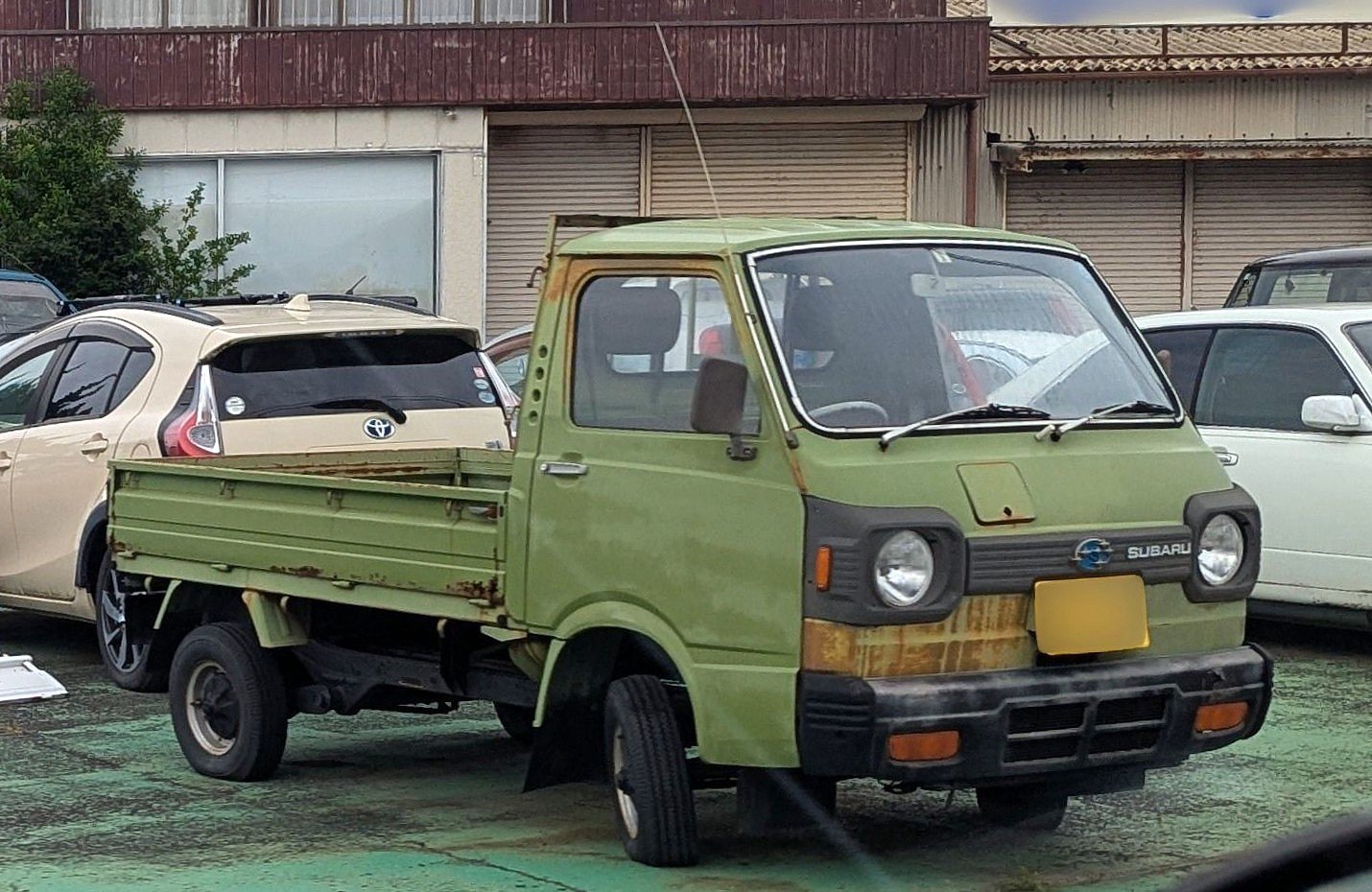
1979 Subaru Sambar
High-roof vans for the one-box boom
The 1979 minor change swapped push-button door handles for flap handles and added high-roof and flat-floor van versions, with a sunroof to follow. Electric windscreen washers spread to every grade around this time.
Year by year
The 1979 model year
What changed for 1979
- High-roof and flat-floor vans added
- Flap-type door handles
Specifications
Subaru-built specifications
These figures cover the whole generation (1961–February 2012); each says which market and model year it applies to.
| Years and markets | Japan: on sale 1 February 1961; Subaru production ended 29 February 2012. Exports: Australia 1961 (about 38 vans and trucks); United Kingdom from August 1985, van only (export versions called Subaru 700) | Wikipedia 2 3 , Fuji Heavy Industries / Subaru Corporation |
|---|---|---|
| Chassis codes | 1961: K151/K161/K162. 1966: K153/K154/K163. 1973: K71/K81/K86/K87/K89. 1982: KR1/KR5/KT1/KT6. 1990: KS3/KS4 (truck), KV3/KV4 (van). 1999: TT1/TT2 (truck), TV1/TV2 (van), TW1/TW2 (Dias Wagon) | Wikipedia , IDOM Inc. (Gulliver, 221616.com) |
| Body styles | Cab-over truck (low deck and high deck), 3-door van, Dias and Try passenger versions | Wikipedia , IDOM Inc. (Gulliver, 221616.com) |
| Assembly plant | Gunma Main Plant, Ōta, Gunma, Japan | Fuji Heavy Industries / Subaru Corporation |
| Engines | Rear-mounted: 360 cc EK32 two-stroke twin (1961); EK21/EK22/EK23 twins (1970s–80s); 544 cc EK23 (1982–90); 658 cc EN07 SOHC four, naturally aspirated or supercharged (1990–2012) | Wikipedia , IDOM Inc. (Gulliver, 221616.com) , Fuji Heavy Industries Ltd. (now Subaru Corporation) |
| Output | 1961: 20 PS (15 kW) at 5,000 rpm, 3.2 kgf·m (31 N·m) at 3,000 rpm. 1966: 30 PS (22 kW) at 6,500 rpm. 1982–90: 28 PS (21 kW) two-valve, 34 PS (25 kW) three-valve. 1990–99: 40 PS (29 kW); supercharged 55 PS (40 kW). 1999–2012: 46–48 PS (34–35 kW); supercharged 58 PS (43 kW) at 6,000 rpm, 74 N·m (55 lb-ft) at 4,000 rpm | Wikipedia , IDOM Inc. (Gulliver, 221616.com) |
| Transmissions | 3-speed manual (1961); 4- and 5-speed manual; ECVT (1990s); 3-speed automatic | Wikipedia , IDOM Inc. (Gulliver, 221616.com) |
| Drive system | Rear engine, rear drive; part-time 4WD from the 1970s; full-time 4WD (viscous with automatic) | Wikipedia , IDOM Inc. (Gulliver, 221616.com) , Fuji Heavy Industries / Subaru Corporation |
| Wheelbase | 1,670 mm (65.7 in) 1961; 1,750 mm (68.9 in) 1966; 1,805 mm (71.1 in) 1982–90; 1,885 mm (74.2 in) 1990–2012 | Wikipedia , IDOM Inc. (Gulliver, 221616.com) |
| Overall length | 2,990 mm (117.7 in) 1961; 3,195 mm (125.8 in) 1973–90; 3,295 mm (129.7 in) 1990–99; 3,395 mm (133.7 in) 1999–2012 | Wikipedia , IDOM Inc. (Gulliver, 221616.com) |
| Width | 1,300 mm (51.2 in) 1961; 1,395 mm (54.9 in) 1973–99; 1,475 mm (58.1 in) 1999–2012 | Wikipedia , IDOM Inc. (Gulliver, 221616.com) |
| Height | 1990–2012: truck 1,760–1,930 mm (69.3–76.0 in); van 1,780–1,920 mm (70.1–75.6 in) | IDOM Inc. (Gulliver, 221616.com) |
| Curb weight | 1999–2012: truck 720–850 kg (1,587–1,874 lb); van 820–970 kg (1,808–2,138 lb) | IDOM Inc. (Gulliver, 221616.com) |
| Fuel capacity | 36 L (9.5 US gal) to 1990; 40 L (10.6 US gal) 1990–2012 | IDOM Inc. (Gulliver, 221616.com) |
| Fuel economy | 2004 Sambar Van VC 4WD 5MT: 16.6 km/L (39 mpg US), Japan 10-15 mode | Fuji Heavy Industries Ltd. (now Subaru Corporation) |
| Base price | 1999–2012 catalog range: 618,000–1,443,000 yen | IDOM Inc. (Gulliver, 221616.com) |
| Production | About 3.64 million Sambars through June 2011 (Subaru); 7,968,000 Subaru minicars of nine models over 54 years a | Fuji Heavy Industries / Subaru Corporation 2 , webCG (Car Graphic) |
- Production. webCG's March 2012 retrospective gives about 3.7 million Sambars over 51 years. ↩
Follow the evidence
Sources
- スバル・サンバー (Japanese Wikipedia)
Sambar generation dates and chassis codes (K151 1961 to KS/KV 1990 to TT/TV/TW 1999 to April 2012, then Daihatsu-supplied S321/S331, S201/S211, S500/S510 and S700/S710), first sale 1 February 1961, first-generation EK32 20 PS figure and 2,990 x 1,300 x 1,520 mm, 1,670 mm wheelbase, and later generations' figures.
Wikimedia Foundation (Japanese Wikipedia contributors) · accessed 2026-11-14 - Sambar WR BLUE LIMITED fiftieth anniversary
1961 origin; about 3.64 million Sambar produced through June 2011. Planned edition limit 1,000 across trucks AND vans. WR Blue Mica, black seats/yellow stitching. Price table distinguishes selective manual 4WD from viscous full-time automatic 4WD; not 1,000 of each body.
Fuji Heavy Industries / Subaru Corporation · accessed 2026-10-07 - End of Subaru mini vehicle production in Japan
Sambar production ended at Gunma Main Plant on 29 February 2012. 7,968,000 is nine Subaru minicar models over 54 years, not Sambar alone. BRZ/86 production scheduled for March, Impreza by March 2013. OEM minicar marketing from Daihatsu continued. URL date differs from release dateline.
Fuji Heavy Industries / Subaru Corporation · accessed 2026-10-07