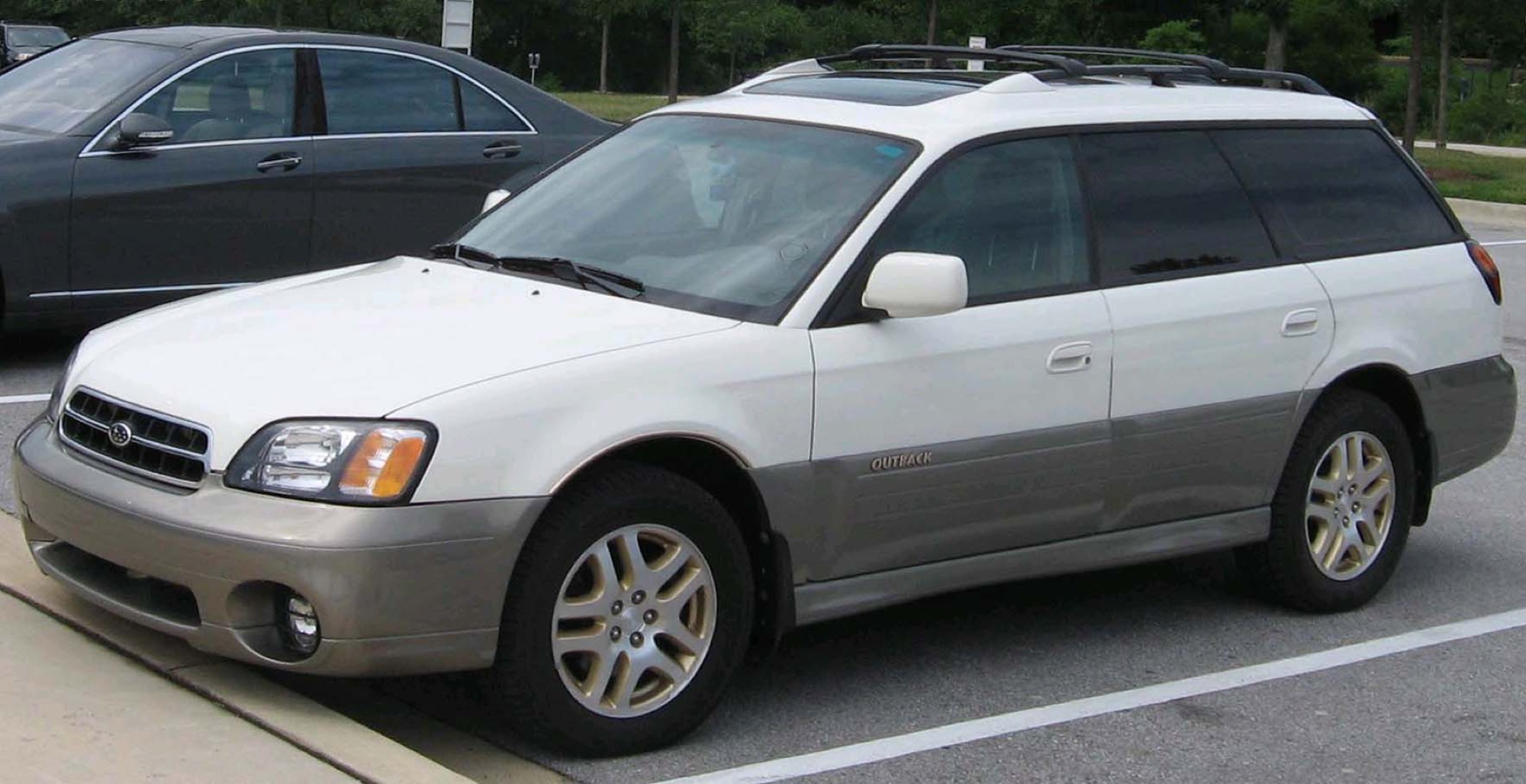
For 2002 the 3.0-liter six went into two sedans, the H6-3.0 and the H6-3.0 VDC. The rest was detail work: variable intermittent wipers, a redesigned center console with two cupholders, door-panel wood trim as standard and Bridgestone Potenza tires. Regatta Red was new, White Frost spread to every model, and Winestone and White Birch were dropped. Base prices held and destination rose $30 to $525. The built-in child seat option ended.
Lafayette Legacy and Outback production, calendar 2002. A blog compilation lists this column as Outback; Subaru of Indiana Automotive built Legacy sedans and wagons on the same line until 2009, so the figure covers both. ↩
Ratings as the EPA lists them at fueleconomy.gov; for 2007 and earlier these are the EPA's revised figures, restated on the test method used since 2008, so they read lower than the original window sticker. Turbocharged and other premium-fuel models are rated on premium gasoline.
NHTSA lists 5 safety recalls that include the 2002 Outback. Not every car is in every recall; a Subaru dealer or NHTSA's VIN lookup shows what is open on one car. Recall repairs are free.
Airtex Products LP (Airtex) is recalling certain model E8598M, E8518M, E8600M, E8596M, and E8597M fuel pumps manufactured July 26, 2013, and July 29, 2013 and used as aftermarket replacements on Subaru Baja's, Outback's and Legacy's. The affected fuel pumps were sold or installed into the aftermarket applications on or after July 26, 2013, and may may leak fuel from the base of a fuel line connection when the gas tank is full.
Risk: A fuel leak in the presence of an ignition source increases the risk of a fire.
Fix: Airtex will notify owners, and will replace the fuel pump, free of charge. Recall is expected to begin on January 2, 2014. Customers may contact Airtex at 1-800-880-3056. The recall is expected to begin during January 2014. This recall is being conducted by Airtex, not by Subaru.
On certain passenger sedans, wagons, and sport utility vehicles, the cruise control cable could come out of its track on the cruise control lever and lodge on the control lever tab when the accelerator pedal is released. If this condition occurs, the throttle will not return to the idle position and will remain in an open position.
Risk: If this occurs during vehicle operation, the driver could lose control of the vehicle, which could result in a crash.
Fix: Dealers will install a cruise control cable retaining clip to the cruise control lever tab on the throttle shaft in order to prevent the cruise control cable from coming out of its track. Owner notification began on april 12, 2004. Owners should contact Subaru at 1-800-782-2783.
This recall applies to certain passenger vehicles originally sold in or currently registered in the states of connecticut, delaware, illinois, Indiana, iowa, kentucky, maine, maryland, massachusetts, michigan, minnesota, missouri, new hampshire, new jersey, new york, ohio, pennsylvania, rhode island, vermont, virginia, west virginia, wisconsin, and the district of columbia. Certain rear suspension subframe components were produced with poor paint quality which, after continued exposure to corrosive road salts for a period of several years, could result in rust-out of the component and possible breakage of the subframe.
Risk: If such breakage occurs while the vehicle is being operated, control of the vehicle could be affected, increasing the risk of a crash.
Fix: Dealers will clean and rust-proof the rear suspension subframe. Owner notification began july 14, 2003. Owners who take their vehicles to an authorized dealer on an agreed upon service date and do not receive the free remedy within a reasonable time should contact Subaru at 1-800-782-2783.
Certain sport utility and passenger vehicles equipped with automatic transmissions were produced with an improperly manufactured transmission parking rod. When the transmission selector lever is placed in the "p" (park) position, the transmission park mechanism, that is intended to hold your vehicle, may not engage.
Risk: The vehicle could then move/roll without prior warning, increasing the risk of a crash.
Fix: Dealers will replace the automatic transmission parking rod assembly. Owner notification january 8, 2003. An interim owner notification will be sent during november 2002. Owners who take their vehicles to an authorized dealer on an agreed upon service date and do not receive the free remedy within a reasonable time should contact Subaru at 1-800-782-2783.
Service brakes, hydraulic: foundation components, master cylinder
On certain passenger vehicles, the brake master cylinders may not function properly in ambient temperatures below freezing 32 degrees fahrenheit and lower).
Risk: At these temperatures, the brakes may not release after being applied, even when the driver's foot is no longer on the brake pedal. This can occur withour prior warning, possibly resulting in a crash.
Fix: Dealers will replace the master cylinders. Owner notification began march 21, 2002. Owners who take their vehicles to an authorized dealer on an agreed upon service date and do not receive the free remedy within a reasonable time should contact Subaru at 1-800-782-2783.
Specifications
Second-generation Outback specifications
These figures cover the whole generation (2000–2004); each says which market and model year it applies to.
Years and markets
U.S. model years 2000–2004 (priced June 1999); Japan as the Legacy Lancaster from September 1998; Australia as the Outback
Height. Wikipedia gives 63.3 in for 2000–2002 wagons and 62.2 in for 2003–2004; Cars101 gives 62.2 in with roof rails and 63.3 in with rails and crossbars for the 2000 car. ↩
Fuel economy. EPA shows cars built before 2008 on its restated 2008 basis, which runs lower than the window stickers of the day. ↩
Sales. Subaru of America's year-end releases give 68,902 for 2000 and 70,625 for 2001. ↩
Buy · Own
Buying and owning a 2002 Outback
Ask for head-gasket service history on a 1996–2004 non-turbo Outback
Ask for head-gasket service history. Repair-trade press describes the naturally aspirated SOHC EJ25 used across 1996–2004 Outback models as prone to a slow head-gasket leak, usually near 100,000 miles. Ask for the service history and any head-gasket receipts.
Watch for slow seepage, not sudden failure. The leak is gradual coolant or oil loss. Look for regular coolant top-offs in the service records and residue at the head-to-block joint.
Confirm the exact engine before assuming the caution applies. The pattern is on the naturally aspirated SOHC EJ25 of this era. The turbocharged XT Outbacks that came later have a different engine; the engine code tells you which you have.
Track coolant level as routine maintenance on a 1996–2004 non-turbo Outback
Repair-trade press describes the naturally aspirated SOHC EJ25 used across these Outback model years as prone to a slow head-gasket leak, usually near 100,000 miles. Check the coolant level at every oil change instead of waiting for a warning light.
A gradual, unexplained need to top off coolant over several fill-ups is the earliest sign reported, not a sudden overheat.
The later turbocharged XT models are not part of this pattern.
Outback origin: conceived by Subaru of America amid mid-1990s sales decline and no SUV entry; body cladding + suspension lift added to the existing Legacy wagon rather than an all-new vehicle (cost-driven decision); named after the Australian outback; Paul Hogan as North American spokesman, explicitly trading on the Australian....
SOHC (vs. DOHC) EJ25 failing "much more frequently"; 1996-2004 as the main affected years; ~100,000-mile failure clustering starting as oil/coolant leak; cross-family engine use (Baja/Forester/Impreza/Legacy/Outback); TSB extending "only to 2008 model year"; standard warranty limits (3yr/36k, 5yr/60k powertrain); 2014 coolant-pellet....
Underhood Service (underhoodservice.com), a trade publication · accessed 2026-07-22
EPA city, highway and combined ratings, engine, transmission, fuel and electric range for every U.S.-market Subaru from model year 1984. Ratings for 2007 and earlier are the EPA's revised figures on the post-2008 method.
U.S. Environmental Protection Agency and U.S. Department of Energy (fueleconomy.gov) · accessed 2026-11-17
30 June 1999 Subaru of America price list for the 2000 Legacy and Outback, from $18,395 (Brighton wagon) and $22,695 (Outback manual), with the statement that all U.S. Legacy and Outback models were built by Subaru-Isuzu Automotive near Lafayette, Indiana.
Subaru of America, Inc., via The Auto Channel · accessed 2026-11-14
20 April 2000 Subaru of America release on the Outback H6-3.0 VDC and H6-3.0 L.L.Bean Edition: 3.0-litre DOHC six at 212 hp and 210 lb-ft, four-speed automatic, VTD all-wheel drive split 45/55 with VDC, McIntosh audio, 7.3 in ground clearance, SIA production.
Subaru of America, Inc., via The Auto Channel · accessed 2026-11-14
Joe Spitz's 2000 Outback page: 165 hp at 5,600 rpm and 166 lb-ft at 4,000 rpm, curb weights 3,415-3,565 lb, 187.4/184.4 in length, 104.3 in wheelbase, 7.3 in ground clearance, 16.9 gal tank, prices including $495 destination.
15 March 2005 release with a Legacy chronology (Gunma Yajima production from November 1988, Japan launch February 1989, U.S. introduction April 1989, SIA production from September 1989, Outback production at SIA from June 1995, GT-B 280 PS June 1996, Lancaster 6 May 2000) and a production table by generation split between Japan and SIA, Outback included.
EPA city, highway and combined mpg for every Legacy and Outback configuration listed from 1990 to 2026, read through the site's public web service by model year, model and vehicle record id. Ratings before 2008 are shown on the 2008 restated basis.
U.S. Department of Energy and U.S. Environmental Protection Agency · accessed 2026-11-14
Resolves multiple chassis-code ambiguities across generations 1-7 (BC/BJ/BF, BD/BG/BK, BE/BH/BT with BT denoting the Baja, BL/BP, BM/BR, BN, BW) and pins the worldwide discontinuation of the standalone Legacy wagon nameplate to the fifth-to-sixth-generation transition (2014/MY2015).