R2 · December 2003 launch
An old name on a new small car.
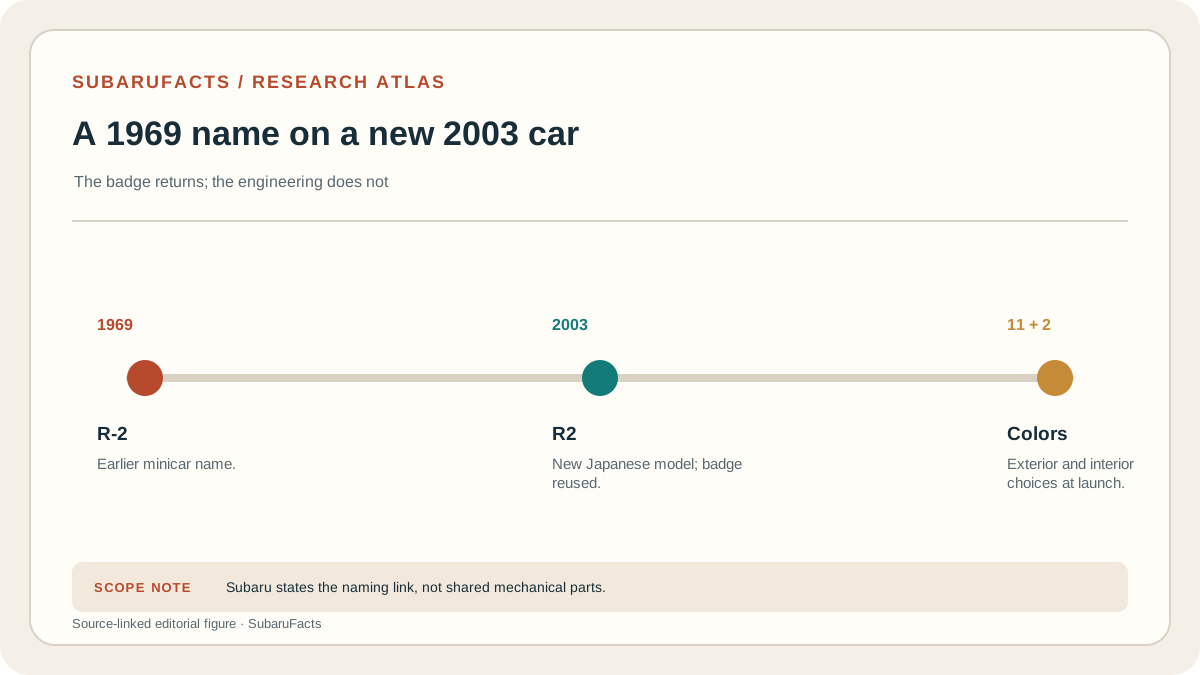
The 2003 R2 launch explicitly revived the name of the 1969 R-2. That naming link does not make them the same platform or engine generation.
Japan · launch record only
SpecificationsValues depend on model year, equipment and market. The cited source for each figure identifies its scope.
Powertrain
Powertrain details
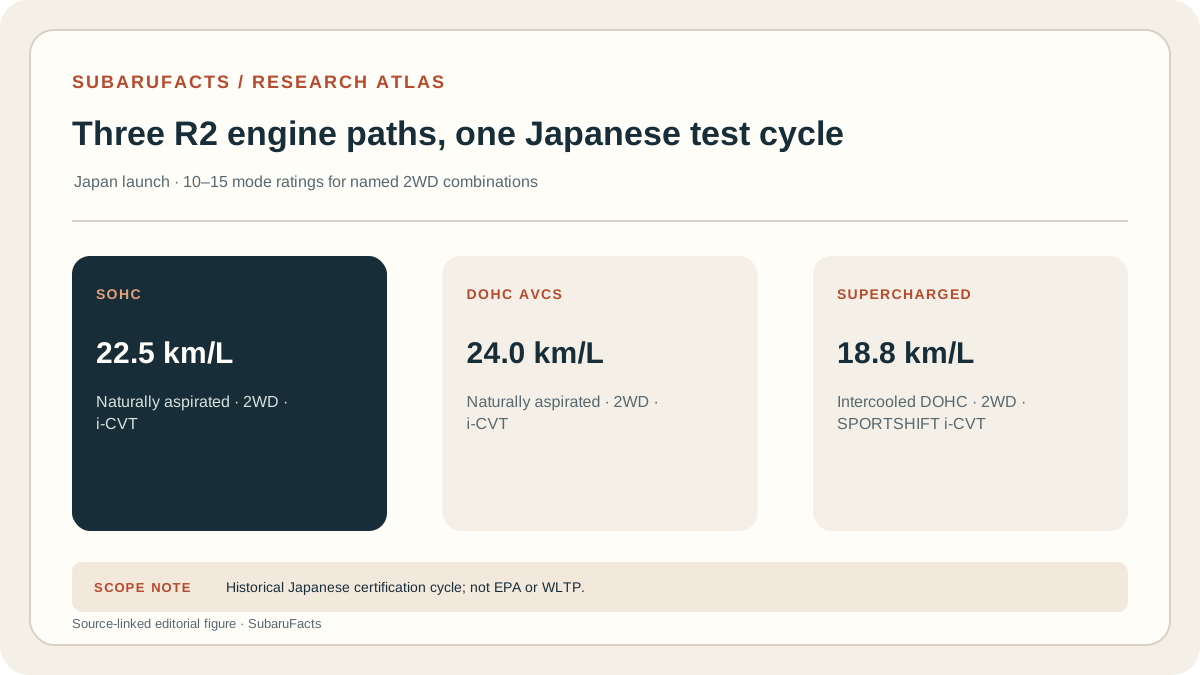
Three engines, three period test figures
The Japanese launch release lists a SOHC engine, a naturally aspirated DOHC 16-valve AVCS engine and an intercooled supercharged DOHC 16-valve engine. Japan’s 10–15 cycle figures are combination-specific: 22.5 km/L for SOHC and 24.0 km/L for AVCS, both 2WD/i-CVT; the supercharged car is listed at 18.8 km/L with 2WD and SPORTSHIFT i-CVT.
These are historical Japanese certification values, not EPA or WLTP ratings. The figures do not isolate engine efficiency from transmission, grade or test protocol.
Evidence: R2 Japanese launch ·
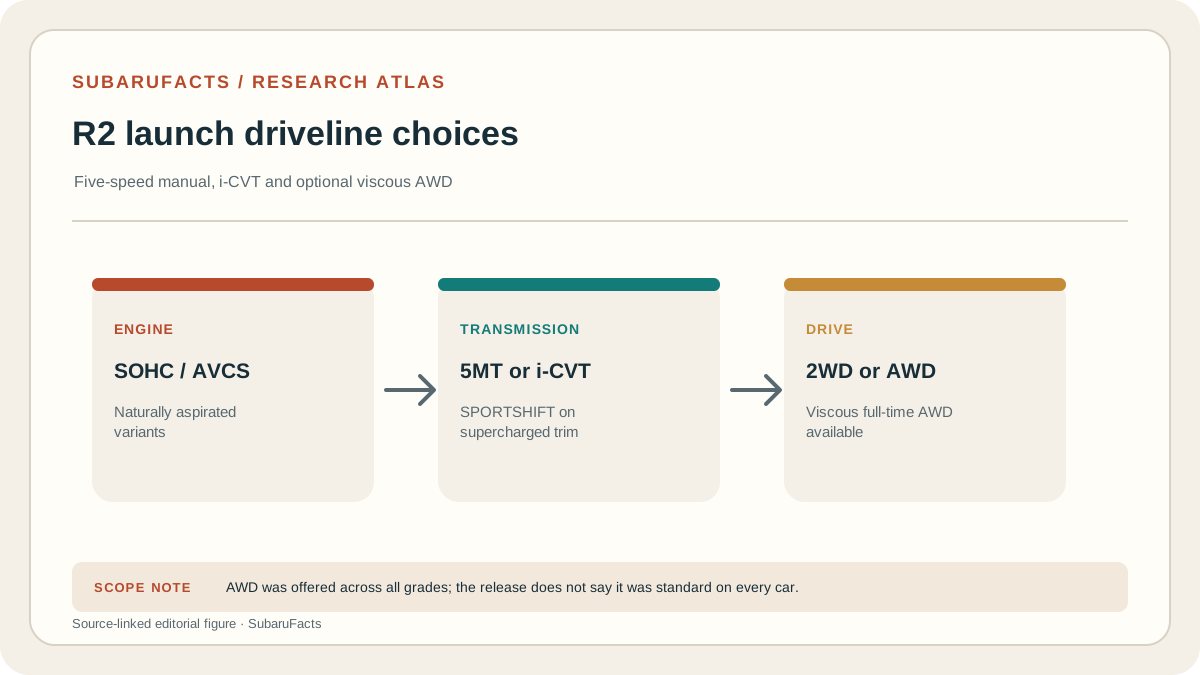
Manual, CVT and AWD choices
Subaru said full-time viscous AWD was available across all grades, not that it was standard on every car. Naturally aspirated versions could also be ordered with a new five-speed manual. Automatic variants used i-CVT; the supercharged model added a seven-step SPORTSHIFT manual mode. The release also specifies four-wheel independent suspension.
For a particular R2, verify the original drivetrain and transmission from the vehicle’s Japanese paperwork or reliable identification records rather than inferring it from the model name.
Evidence: R2 Japanese launch ·
Configuration
Model details
The name returned; the car was new
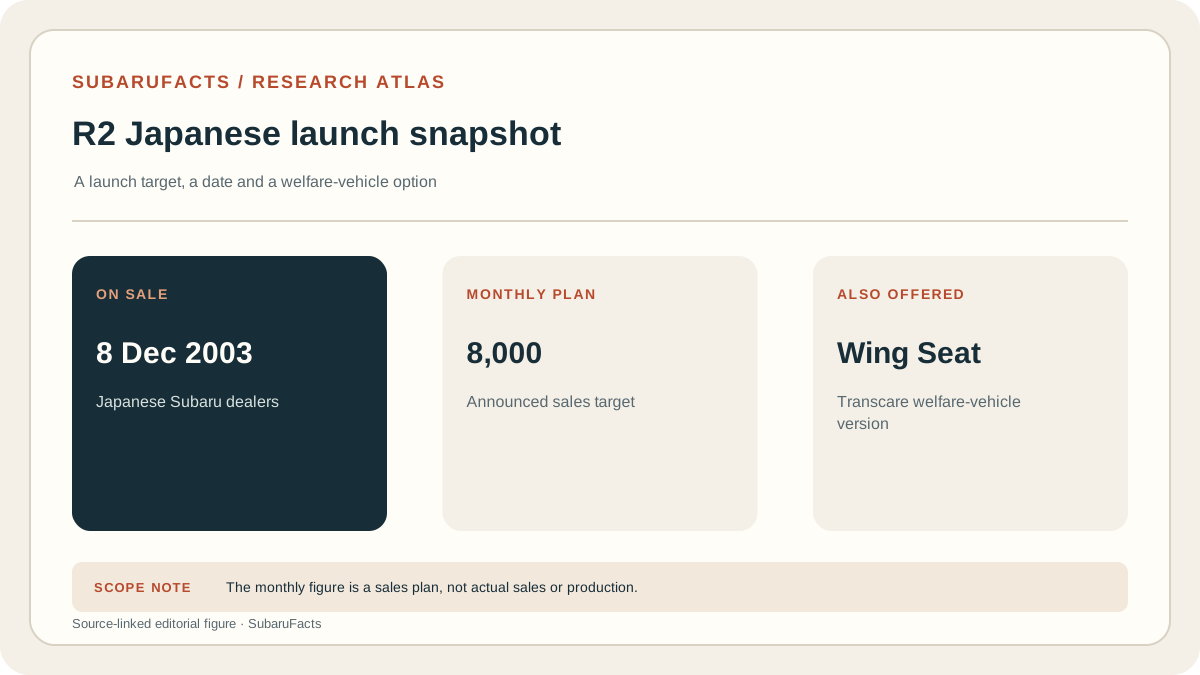
Fuji Heavy Industries announced the Japanese R2 on 8 December 2003. Its release says the name deliberately recalls the 1969 R-2, while describing the newer car as a new kei model. That is a naming link, not a claim that the two cars shared a platform or mechanical specification.
Subaru described the R2’s one-motion body and an aircraft-inspired Spread Wings grille as design choices expressing the company’s roots. The launch palette had eleven exterior colors and two interior colors; later years and grades may differ.
Evidence: R2 Japanese launch ·
SOHC, DOHC AVCS and supercharged alternatives; read each drivetrain/engine against its own brochure.
Identify & buy
Identification and ownership notes
Descriptive model label; no chassis decoding or individual-vehicle authenticity inferred.
Follow the evidence
Sources for this page
- R2 Japanese launch
New R2 reuses the 1969 R-2 name, not its mechanics. SOHC, DOHC AVCS and supercharged engine alternatives. Japanese 10–15 fuel cycle numbers are configuration-specific, not EPA/WLTP.
Fuji Heavy Industries · accessed 2026-10-07